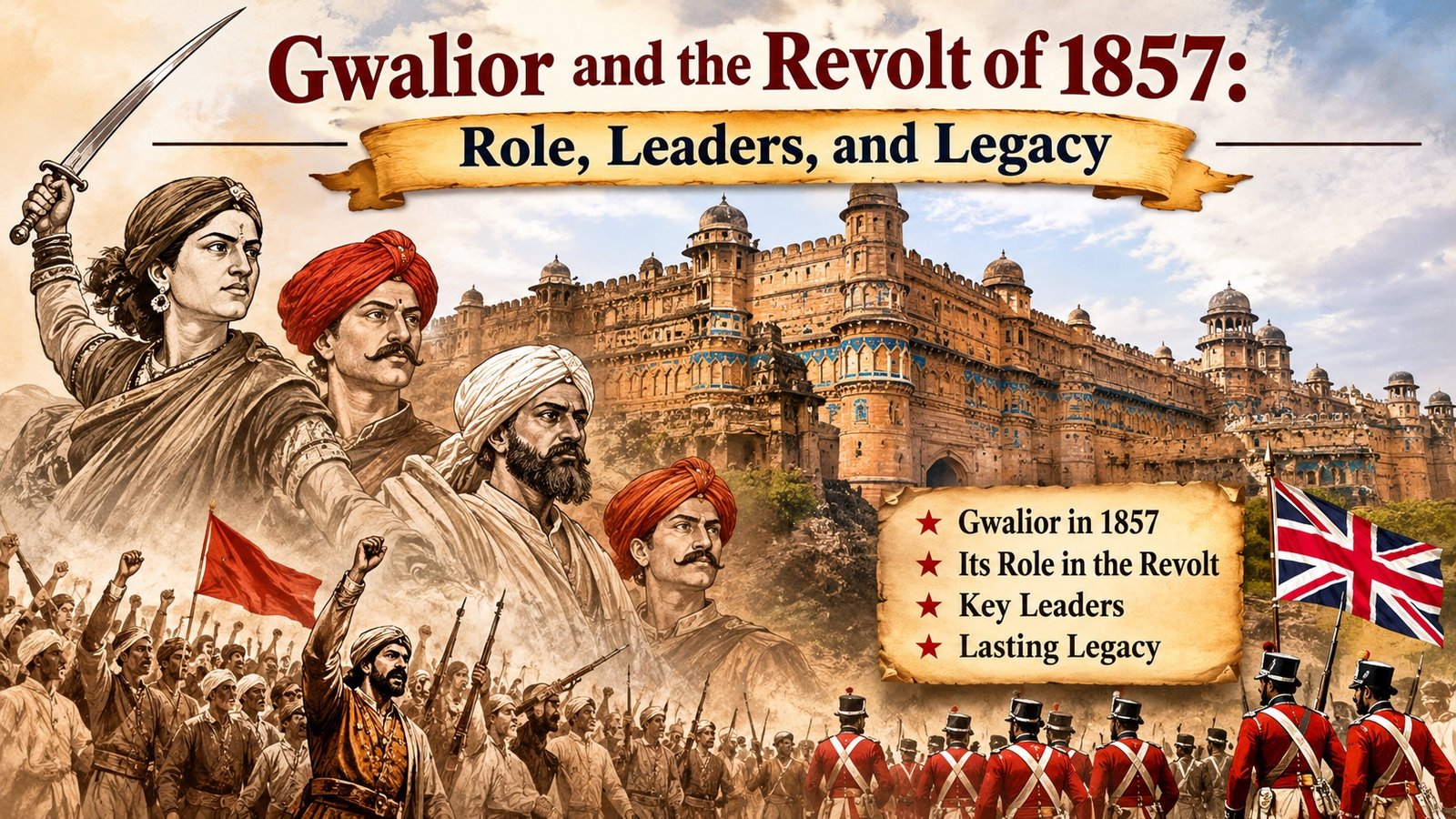
Gwalior and the Revolt of 1857: Role, Leaders, and Legacy
Gwalior was one of the most important centres of the Revolt of 1857 in Central India. Although the ruler of Gwalior, Maharaja Jayajirao Scindia, supported the British, a large number of his soldiers joined the rebels. Because of this, Gwalior became a major battlefield and the final centre of resistance under Rani Lakshmibai in 1858.
Background of the Revolt
The Revolt of 1857 began as a rebellion of Indian soldiers against the East India Company, but it soon spread across North and Central India. People were angry because of British expansion, high taxes, interference in religion and customs, and the unfair policy of annexing Indian states.
In Central India, Jhansi, Gwalior, and Kalpi became important centres of resistance. Gwalior was especially important because it was the capital of the powerful Scindia state and had a strong army, fort, and treasury.
Role of Gwalior in the Revolt
Maharaja Jayajirao Scindia decided to remain loyal to the British. However, many soldiers of the Gwalior army did not agree with this decision. They sympathised with the rebels and wanted to fight against British rule.
After the defeat at Jhansi and Kalpi, Rani Lakshmibai and Tantia Tope moved towards Gwalior. On 1 June 1858, the rebel forces entered Gwalior and captured the city. Maharaja Scindia fled from Gwalior, and the rebels took control of the Gwalior Fort and treasury.
The capture of Gwalior gave new hope to the rebels. It showed that even after major defeats, the struggle against the British was not over. But the British government sent a strong army under Sir Hugh Rose to recapture Gwalior.
Major Leaders Associated with Gwalior
| Leader | Role in the Revolt |
|---|---|
| Rani Lakshmibai | The Queen of Jhansi and the greatest leader of the revolt in Central India. After losing Jhansi and Kalpi, she came to Gwalior, captured it with rebel forces, and organised resistance against the British. |
| Tantia Tope | A brave military commander and close associate of Nana Sahib. He fought alongside Rani Lakshmibai in Gwalior and continued guerrilla warfare after the fall of the city. |
| Nana Sahib | A major rebel leader of Kanpur. He was connected with the wider rebel movement and supported the anti-British struggle in North and Central India. |
| Maharaja Jayajirao Scindia | The ruler of Gwalior. He supported the British during the revolt, although many of his soldiers joined the rebels. |
| Soldiers of Gwalior | Many Gwalior soldiers joined Rani Lakshmibai and Tantia Tope. Their support helped the rebels capture Gwalior in June 1858. |
Battle of Gwalior
The Battle of Gwalior took place in June 1858. British forces under Sir Hugh Rose attacked the rebels and first captured Morar, an important area near Gwalior. After this, they advanced towards the main city and the Gwalior Fort.
Rani Lakshmibai fought with great courage. She personally led her soldiers against the British army. In the battle near Kotah-ki-Serai, she was seriously wounded while fighting British cavalry. She died on 17 or 18 June 1858.
After the death of Rani Lakshmibai, the rebel resistance became weak. The British recaptured Gwalior and restored the authority of Maharaja Scindia. The defeat at Gwalior practically ended the Revolt of 1857 in Central India.
Importance of Gwalior
- Gwalior was the last major centre of the Revolt of 1857.
- It became the final battlefield of Rani Lakshmibai.
- The revolt showed the conflict between the loyal princely ruler and rebel-minded soldiers.
- The British victory at Gwalior ended organised resistance in Central India.
- After the revolt, the British Crown took direct control of India from the East India Company in 1858.
Legacy of Gwalior in the Freedom Struggle
Gwalior gave the Revolt of 1857 its most inspiring hero, Rani Lakshmibai. Her courage, sacrifice, and refusal to surrender made her an eternal symbol of patriotism in India.
The revolt also proved that the desire for freedom was not limited to kings and queens. Soldiers, local chiefs, and common people also participated in the struggle. Although the revolt failed, it created a strong feeling of resistance against British rule.
Today, Gwalior is remembered as the land of Rani Lakshmibai’s final battle. Her sacrifice continues to inspire the people of India, especially the youth, to value courage, unity, and love for the motherland.
Conclusion
Gwalior played a decisive role in the Revolt of 1857. It was here that Rani Lakshmibai made her last stand against the British. Although the revolt was suppressed, the bravery shown at Gwalior became an important part of India’s freedom struggle. The legacy of Gwalior reminds us that the fight for independence was carried forward by countless heroes whose sacrifice laid the foundation of modern India.



Comments
No comments yet. Be the first to comment.